Poker has earned its place as one of the most respected card games in the entire casino industry, and UK players continue to search it out for good reason. Unlike pure chance-based games, poker rewards patience, hand-reading and disciplined bankroll decisions, which is exactly why it has such a loyal following among both casual players and serious grinders.
At Midnite Casino, poker sits alongside a wide catalogue of table games and is built to work smoothly whether you’re playing from a laptop after work or from a phone during a commute. This guide walks through everything a UK player needs to know before sitting down at a table, from the rules and hand rankings through to strategy, limits and how the game behaves differently in live and RNG formats.
Whether you’ve played poker at home with friends for years or you’re stepping into an online casino poker room for the first time, the sections below are structured to answer the practical questions players actually ask: how the betting rounds work, what separates one poker variant from another, and how to manage a bankroll sensibly across a session.
What Is Poker?
Poker is a card game built around betting rounds, hand rankings and, in many popular variants, a combination of private cards and shared community cards. The objective is straightforward on paper: either hold the best five-card hand at showdown or convince every other player at the table to fold before that point is reached. In practice, the skill lies in reading betting patterns, calculating odds and knowing when to commit chips versus when to hold back.
In a casino setting, poker is typically offered either as a player-versus-player format (where the house simply takes a rake or time charge) or as a player-versus-dealer format such as Casino Hold’em, where a dealer’s hand acts as the opponent. Online casinos frequently lean towards the dealer-versus-player structure because it allows for a fixed house edge and instant, self-contained rounds rather than requiring a full table of matched opponents.
This distinction matters for UK players because it changes how the game should be approached strategically. Player-versus-dealer poker games follow published optimal strategy charts with a known house edge, while player-versus-player formats depend heavily on the skill level of the opponents at the table.
How to Play Poker Step by Step
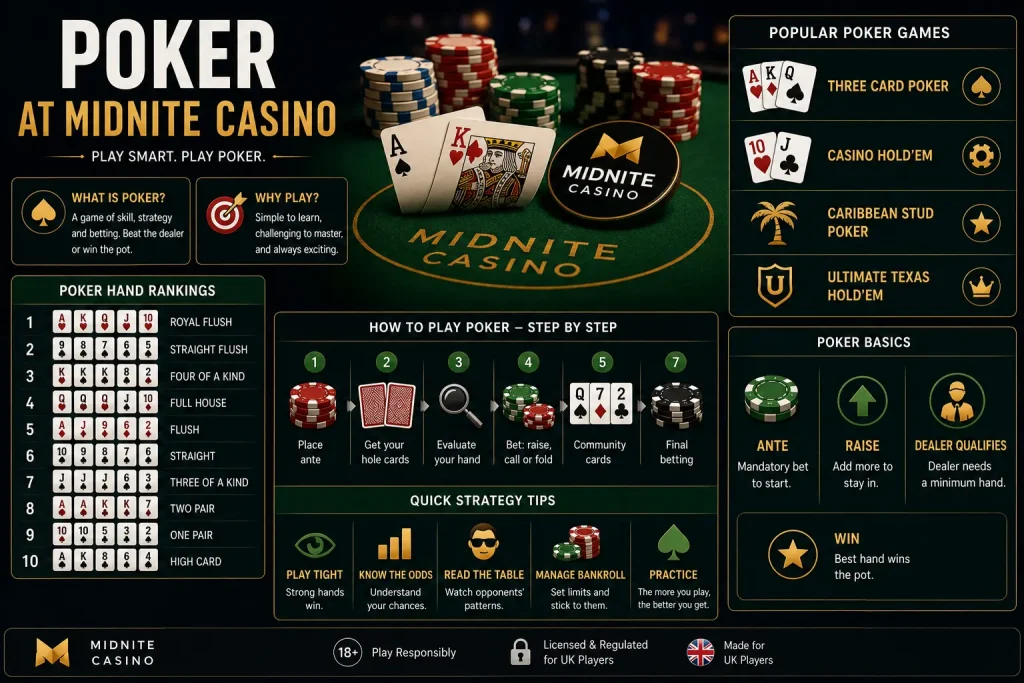
Getting started with poker at an online casino is more approachable than many newcomers expect, provided the sequence of a round is understood clearly. Below is a general walkthrough that applies to most casino poker formats, adapted for a dealer-based table game structure.
- Place the required ante or opening wager before any cards are dealt.
- Receive your starting cards, known as hole cards, which only you can see.
- Review your hand strength against the posted pay table or against the visible action at the table.
- Decide whether to raise, call or fold based on your hand and the community cards revealed so far.
- Watch as community cards (where applicable) are dealt across the flop, turn and river stages.
- Make any further betting decisions as new cards appear.
- Reach showdown, where remaining hands are compared using standard poker hand rankings.
- Collect winnings if your hand is ranked highest, or if all opponents have folded before showdown.
Once this sequence becomes familiar, the pace of a round feels natural. Online formats speed this up considerably compared to a live card room, since betting decisions are made through simple on-screen buttons rather than physical chip movements.
Before diving into a real-money table, it’s worth spending time on Midnite Casino’s casino games section, where the wider poker selection and related card games are laid out clearly, making it easier to compare variants before committing any funds.
Poker Rules Explained
The foundation of every poker variant is the hand ranking system, which determines who wins at showdown. From strongest to weakest, the standard order runs: Royal Flush, Straight Flush, Four of a Kind, Full House, Flush, Straight, Three of a Kind, Two Pair, One Pair, and High Card. Every casino poker format, regardless of how the cards are dealt, resolves winning hands using this same hierarchy.
Betting structure is the second core rule set to understand. Most casino poker games use fixed betting rounds tied to specific stages of the deal — for example, an ante placed before cards are shown, followed by a raise-or-fold decision once hole cards are seen, and sometimes a further decision once community cards appear. Each stage typically has a defined maximum bet relative to the ante, which keeps the structure predictable for players new to the format.
Qualifying hands are another rule worth understanding, particularly in dealer-versus-player formats. Some casino poker variants require the dealer’s hand to reach a minimum strength (commonly a pair or higher) to “qualify.” If the dealer fails to qualify, ante bets are often paid out automatically regardless of the raise outcome, which is a detail that materially affects the game’s overall house edge.
| Rule Element | Description | Impact on Play |
|---|---|---|
| Hand Ranking Order | Royal Flush down to High Card | Determines the winner at showdown |
| Ante Wager | Mandatory bet before cards are dealt | Sets the base unit for later raises |
| Dealer Qualification | Minimum hand strength for dealer to compete | Affects payout of ante if dealer misses |
| Community Cards | Shared cards revealed across betting rounds | Used in variants like Casino Hold’em |
Popular Poker Variants
Poker is not a single fixed game but a family of related formats, each with its own dealing structure and betting rhythm. UK casino players will typically come across a handful of these variants, and knowing the differences helps in choosing the one that suits a particular playing style.
Casino Hold’em is one of the most widely available formats online, adapted directly from Texas Hold’em but restructured as a player-versus-dealer game. Community cards are shared, and the player competes solely against the dealer’s hand rather than a full table of opponents.
Three Card Poker strips the format down to a fast, three-card hand comparison against the dealer, with an optional side wager (Pair Plus) that pays based on the player’s hand alone, independent of the dealer’s result.
Caribbean Stud Poker uses a five-card hand dealt to both player and dealer, with the player deciding whether to raise or fold after seeing one of the dealer’s exposed cards, and often includes a progressive jackpot side bet.
Ultimate Texas Hold’em follows a similar community-card structure to Casino Hold’em but allows for larger raises earlier in the hand, giving skilled players more room to apply strategic decision-making relative to the fixed ante.
Core Game Mechanics: Cards and Dealing
Every poker variant is built on a standard 52-card deck, shuffled either physically by a live dealer or virtually through a certified random number generator in RNG-based online formats. Hole cards are dealt face down to the player, while community cards (in variants that use them) are placed face up in the centre of the table for everyone to see.
The dealing sequence matters because it controls the pacing of decisions. In formats such as Casino Hold’em, cards are typically revealed in stages — the flop bringing three community cards, followed by the turn and river adding one card each — mirroring the structure familiar from traditional Texas Hold’em, but with the betting simplified into fewer discrete decision points.
Card values follow standard poker convention, with Aces able to play either high or low depending on the hand being formed, and suits carrying no relative rank against one another. Understanding how these mechanics interact with the specific betting rounds of a chosen variant is essential before wagering real money.
Main Betting Actions and Player Decisions
Every poker variant available at Midnite Casino revolves around a set of core decisions a player makes as the hand develops. Recognising each action and when it applies is one of the fastest ways to become comfortable at the tables.
- Ante: The mandatory opening bet placed before any cards are seen.
- Call: Matching a prior bet to remain active in the hand.
- Raise: Increasing the wager after reviewing your hand or the community cards.
- Fold: Forfeiting the hand and any ante already placed to avoid further loss.
- Check: Passing the action without betting when no wager is required to continue.
- Side Bet: An optional additional wager, such as Pair Plus or a progressive jackpot bet, resolved independently of the main hand.
- Blind Wager: A secondary mandatory bet used in community-card variants such as Casino Hold’em.
- Showdown: The comparison of remaining hands once all betting rounds are complete.
Each of these actions carries different strategic weight depending on the variant being played. A raise in Three Card Poker, for example, is typically a fixed multiple of the ante, whereas Ultimate Texas Hold’em allows raise sizing to shift depending on which stage of the hand the decision is being made in.
| Action | When It Applies | Possible Outcome |
|---|---|---|
| Ante | Start of every hand | Establishes stake required to see cards |
| Raise | After viewing hole or community cards | Increases potential payout if hand wins |
| Fold | When hand strength is weak | Forfeits ante, limits further loss |
| Side Bet | Before the hand begins, optional | Independent payout regardless of dealer result |
| Showdown | Final stage of the hand | Hands compared using standard rankings |
Betting Limits at Midnite Casino
Betting limits for poker tables vary depending on the specific variant and whether the table is live-dealer or RNG-based. Casual players will generally find ante minimums set low enough for relaxed, low-stakes sessions, while higher-limit tables cater to players looking to wager more substantially per hand.
As a general guide, ante wagers commonly start from a modest per-hand minimum and scale up to considerably higher maximums on dedicated high-roller tables. Since exact limits can shift between variants and are subject to change, players should always confirm the current minimum and maximum stakes directly on the table interface before placing a wager.
RTP in Poker
Return to Player (RTP) in dealer-versus-player poker formats is generally fixed and published by the game provider, reflecting the theoretical percentage of wagers returned to players over a large number of hands when optimal strategy is applied. Variants such as Casino Hold’em and Three Card Poker typically carry an RTP in the mid-to-high 90s when played with correct strategy, though the exact figure depends on the specific game studio and ruleset in use.
It’s worth noting that RTP figures assume long-run play and optimal decision-making at every stage. A single session, whether short or extended, can and will deviate from the theoretical RTP simply due to natural variance in card distribution.
House Edge Explained
The house edge in casino poker is the mirror image of RTP and represents the built-in advantage the casino holds over time. Correct strategic play — folding weak hands promptly and raising strong ones appropriately — keeps the house edge as low as the game’s mathematical design allows. Deviating from optimal strategy, such as calling with hands that should be folded, increases the effective house edge significantly.
Side bets, including progressive jackpot wagers, typically carry a noticeably higher house edge than the main hand itself. These are often included for their large potential payouts rather than favourable long-term odds, and should be approached with that trade-off in mind.
Live Poker at Midnite Casino
Live poker brings the atmosphere of a real card room directly to a screen, streamed from a professional studio with a human dealer managing the shuffle, deal and payout process. For UK players who enjoy the social and visual elements of in-person play, this format closes much of the gap between online convenience and traditional casino floor experience.
Live tables typically move at a steadier pace than RNG versions, giving players more time to consider each decision. Chat functionality with the dealer, visible card handling and real-time interaction all contribute to a format that many experienced players prefer once they’ve become comfortable with the underlying rules.
Online (RNG) Poker
RNG-based poker uses certified random number generation to shuffle and deal virtual cards, offering a considerably faster pace than live tables. Rounds resolve in seconds, making this format well suited to players who want quick decisions without the wait times associated with a live studio.
Because RNG poker doesn’t rely on a live dealer or studio schedule, it’s available continuously, which suits players looking for a session outside of peak live-table hours. The fairness of these games is maintained through independent testing and certification of the underlying random number generator.
Mobile Poker Experience
Midnite Casino’s poker tables are built to run smoothly on both Android and iPhone devices, whether accessed through a dedicated app or directly via a mobile browser. There’s no need to download anything extra to try the demo versions — most variants can be tested directly in-browser without registration, giving new players a risk-free way to learn the rules first.
Touchscreen controls are laid out clearly for betting actions like raise, call and fold, and card visuals scale appropriately for smaller screens without losing readability. For players who split time between desktop and mobile, session settings and history typically carry across devices once logged into an account.

Demo Play vs Real Money Poker
Demo mode is one of the most useful tools available to new poker players, allowing full access to a variant’s rules, betting structure and pacing without any financial risk. It’s an effective way to learn hand rankings and betting decisions before committing real funds, particularly for unfamiliar variants like Ultimate Texas Hold’em.
Real money play, by contrast, introduces the psychological and financial weight that demo mode simply can’t replicate. Bet sizing decisions feel different when actual funds are on the line, which is why many experienced players recommend spending meaningful time in demo mode before transitioning to wagering with real balance.
Beginner Strategy for Poker
Strategy in casino poker variants generally comes down to disciplined hand selection. In formats like Casino Hold’em or Ultimate Texas Hold’em, published optimal strategy charts exist that outline exactly which starting hands justify a raise and which should be folded, based purely on mathematical expectation rather than gut feeling.
New players often make the mistake of calling or raising with borderline hands out of impatience. Sticking closely to a known strategy chart for the specific variant being played, rather than improvising, is one of the most reliable ways to keep the house edge as low as the game allows. No strategy guarantees a win on any individual hand, since short-term card distribution remains inherently unpredictable.
It’s also worth learning the qualification rules of whichever variant is being played, since these directly affect how often ante bets pay out independently of the raise decision, and should factor into how aggressively a player chooses to raise on marginal hands.
Bankroll Management
Setting a session bankroll before sitting down at any poker table is one of the simplest habits that separates sustainable play from erratic play. A common approach is to decide on a fixed amount for the session in advance and treat that figure as the hard limit, regardless of how the cards fall.
Bet sizing relative to bankroll matters too. Wagering a small percentage of the total session bankroll per hand allows for natural variance to play out without risking the entire balance on a short losing stretch. Tracking wins and losses across sessions, rather than focusing only on individual hands, gives a clearer picture of long-term play and helps keep decisions grounded rather than emotional.
Advantages and Disadvantages of Playing Poker
Like any casino game, poker comes with a mix of strengths and trade-offs worth weighing before choosing it as a regular game. The table below summarises the main points UK players tend to raise when comparing poker to other casino card games.
| Advantages | Disadvantages |
|---|---|
| Skill and strategy directly influence outcomes | Learning curve steeper than simpler games |
| Wide range of variants to suit different paces | Side bets often carry a higher house edge |
| Available in both live and RNG formats | Optimal strategy charts require memorisation |
| Demo mode allows risk-free practice | Slower pace on live tables compared to RNG |
Similar Casino Games Worth Exploring
Players who enjoy the strategic decision-making of poker often find themselves drawn to other card-based casino games with comparable mechanics. Blackjack, for instance, shares the appeal of hand-value calculation and clear optimal-strategy charts, while baccarat offers a more streamlined, faster-paced card comparison format for those who prefer simpler decisions.
For a full look at what else is on offer alongside poker, the casino games catalogue at Midnite Casino brings together the full range of card, table and live-dealer titles in one place, making it straightforward to explore variants and related games without leaving the site.
Responsible Gambling
Poker should always be approached as a form of entertainment rather than a reliable way to generate income. Setting deposit limits, session time reminders and loss limits before playing helps keep the experience enjoyable and within personal comfort levels. Midnite Casino provides tools to set these boundaries directly within account settings, and UK players can also access independent support through organisations such as GamCare or the National Gambling Helpline whenever needed.
Recognising the early signs of problematic play — chasing losses, exceeding a planned budget, or playing for longer than intended — is far easier when a bankroll and time limit have been agreed in advance. Taking regular breaks and stepping away from the table when a session isn’t going as planned are simple habits that protect both bankroll and mindset over the long run.
Anyone wanting a broader overview of the platform, its licensing and its full range of games can visit Midnite Casino directly, where account tools and responsible gambling resources are laid out clearly for every UK player.
Frequently Asked Questions
Is poker at Midnite Casino fair and properly regulated?
Yes, poker games at Midnite Casino run on certified random number generators for RNG formats, while live tables are streamed from licensed studios with independently audited dealing processes, giving UK players confidence in fair outcomes across every hand played.
Can I play poker for free before wagering real money?
Most poker variants at Midnite Casino offer a demo mode accessible directly through the browser without registration, allowing new players to learn hand rankings, betting rounds and variant-specific rules before ever placing a real-money wager.
What’s the difference between live and RNG poker?
Live poker is streamed from a studio with a human dealer managing the shuffle and deal in real time, offering a slower, more social pace, while RNG poker uses certified software to resolve rounds within seconds, suiting players who prefer a faster, solo-paced session.
Do I need to download an app to play poker on mobile?
No download is required to try most poker variants, since they run directly through a mobile browser on both Android and iPhone devices, with full demo access available before any account registration is needed.
Which poker variant is best for beginners?
Three Card Poker is often recommended for newcomers because its rules are simpler and hands resolve quickly, while variants like Ultimate Texas Hold’em involve more decision points and are better suited to players already comfortable with community-card structures.
Does using optimal strategy guarantee a win in poker?
No strategy, however well studied, guarantees winning any individual hand, since card distribution remains inherently random. Optimal strategy charts simply minimise the house edge over the long run rather than eliminating short-term variance.