
Responsible Gambling: A Complete Safer Gambling Guide for UK Players
At Midnite Casino, we believe gambling should always remain a form of entertainment — never a source of debt, stress, or personal harm. We are fully committed to promoting safer gambling values throughout every piece of content we publish, and we take our responsibility to UK readers seriously. This page exists as a dedicated resource to help you gamble more safely, recognise when things are going wrong, and access the support you need.
The United Kingdom has some of the strongest player protection frameworks in the world, overseen by the UK Gambling Commission. Even so, gambling harm affects hundreds of thousands of people in the UK every year, and many more are impacted indirectly as friends, partners, or family members. Understanding the risks, knowing the tools available to you, and being honest about your own habits are the most powerful things you can do to keep gambling enjoyable.
Please read this page carefully. If anything here resonates with your own experience, or if you have concerns about someone close to you, the support organisations listed throughout this page are staffed by trained professionals who can help — many of them completely free of charge, 24 hours a day.
What Safer Gambling Actually Looks Like
Responsible gambling means treating gambling purely as paid entertainment — something you do for enjoyment, within a budget you can afford to lose without any negative consequences for your finances or lifestyle. A responsible gambler decides in advance how much time and money they are willing to spend, and they stick to those boundaries regardless of whether they are winning or losing.
There is no such thing as a guaranteed winning system in casino games. Every spin of a slot machine, every roulette result, and every card dealt is governed by random number generation and probability — outcomes that no strategy can reliably predict or control. Keeping this reality in mind is one of the most important foundations of safer gambling. When gambling feels exciting and enjoyable within your chosen limits, it is working as it should. When it starts to feel compulsive, stressful, or financially necessary, it has crossed into harmful territory.
Safer gambling also means using the protective tools available to you — deposit limits, session time reminders, cooling-off periods, and self-exclusion programmes — not just in crisis moments, but proactively, as a normal part of how you engage with gambling. These tools are available at all UK-licensed casinos as a regulatory requirement, and making use of them is a sign of sensible self-management, not weakness.
Recognising the Warning Signs of Gambling Harm
Gambling harm rarely appears suddenly. It tends to develop gradually through a pattern of small behavioural changes that, taken together, shift gambling from a hobby into something harmful. Recognising these changes early — in yourself or in someone you care about — dramatically improves the prospects of a successful recovery.
Behavioural Warning Signs
- Spending much more time or money gambling than you originally planned
- Returning to gamble in order to recover money you have already lost — known as “chasing losses”
- Lying to friends, family, or colleagues about how much you gamble or spend
- Neglecting work, studies, family responsibilities, or social commitments because of gambling
- Borrowing money, using credit, or selling possessions to fund gambling activity
- Gambling with money that was set aside for essential bills or household expenses
- Feeling irritable, restless, or anxious when you try to stop or reduce gambling
Emotional and Psychological Warning Signs
- Using gambling as a way to escape stress, boredom, loneliness, or difficult emotions
- Experiencing intense mood swings linked to gambling results — high elation after wins, despair after losses
- Believing you are “due” a win after a long losing streak, or that a big win is just around the corner
- Feeling a constant preoccupation with gambling — planning the next session, reliving past wins
- Needing to bet larger and larger amounts to feel the same level of excitement
- Feeling guilt or shame about your gambling behaviour but finding it hard to stop
If you recognise three or more of these signs in your own life, please reach out to a support service. GamCare offers a free, confidential helpline — 0808 8020 133 — available 24 hours a day, seven days a week. You do not need to be in crisis to call. Their advisors are experienced, non-judgemental, and genuinely helpful at every stage of gambling difficulty.
The Real Consequences of Problem Gambling
Problem gambling is often called a hidden addiction because its consequences are less visible than some other forms of harm — but they are no less serious. The financial, emotional, and relational damage caused by out-of-control gambling can take years to fully recover from, and understanding the full picture is important for anyone who wants to take early warning signs seriously.
Financial Damage
The financial consequences of gambling disorder frequently extend far beyond the money spent at the casino itself. Debt accumulated through credit cards, payday loans, and informal borrowing from family and friends is common among people experiencing gambling problems. In severe cases, gambling-related debt leads to housing insecurity, bankruptcy, and long-term damage to credit ratings. These financial consequences create chronic stress that affects every area of life long after gambling activity has stopped.
Emotional and Mental Health Impact
Anxiety, depression, shame, and social isolation are strongly associated with gambling harm — they can be both a cause and a consequence of problematic behaviour. Many people experiencing gambling disorder live with intense secrecy for extended periods, which compounds the psychological burden significantly. In the most serious cases, gambling disorder is associated with suicidal ideation. If you are experiencing thoughts of harming yourself, please contact Samaritans immediately on 116 123 — free, confidential, and available at any hour.
Relationships and Family Life
Gambling addiction affects not only the person gambling but everyone close to them. Partners, children, and parents all feel the impact through broken trust, financial hardship, and emotional unavailability. These relationships can be repaired, but it takes time, honesty, and usually professional support for everyone involved.
Common Gambling Myths Worth Dismissing
Myth: “I can win back my losses if I keep playing.”
Every casino game outcome is statistically independent of previous results. No bet you place today is influenced by what happened yesterday. Chasing losses is one of the fastest routes to serious financial harm — walk away instead.
Myth: “Gambling problems only affect people who are irresponsible with money.”
Gambling disorder can affect anyone regardless of income, education, or financial background. High earners are not protected — in fact, larger disposable income can sometimes delay recognition of a developing problem.
Myth: “I can stop whenever I want to.”
Most people who develop a gambling problem genuinely believed this at some point. Addiction changes the brain’s reward pathways in ways that make stopping far harder than it appears. Difficulty stopping is not a character flaw — it is a health issue that responds well to professional support.
Myth: “Using responsible gambling tools means admitting I have a problem.”
Deposit limits, cooling-off periods, and GAMSTOP registration are tools used by millions of recreational gamblers who simply want to stay in control. Using them proactively is a sign of good self-management, not disorder.
Practical Safer Gambling Strategies
The most effective approach to safer gambling combines honest self-assessment with concrete, pre-committed rules that you apply before every session — not during it. In-the-moment decisions made when you are already engaged in gambling are rarely as sound as decisions made in advance with a clear head.
- Set a fixed session budget in advance — treat it as an entertainment expense, the same as a cinema or restaurant outing. Once it is spent, the session ends immediately.
- Use a separate payment method for gambling — a prepaid card or dedicated e-wallet makes spending far easier to track and prevents accidental overspend.
- Set a time limit for every session — use your phone alarm or the in-built session timer available at all UK-licensed casinos. When the alarm sounds, stop.
- Never gamble when you are stressed, upset, or under the influence of alcohol — these conditions impair judgement and dramatically increase the risk of reckless betting.
- Keep a simple gambling diary — note the date, amount spent, and how you felt at the end of each session. Patterns in the data often reveal things we would otherwise ignore.
- Maintain other leisure activities — if gambling is your primary form of relaxation, the risk of dependency is significantly higher. Protect time for physical exercise, social activities, and creative hobbies.
For free, comprehensive guidance on evidence-based safer gambling habits tailored to UK players, BeGambleAware is the best starting point. Their website includes a private online self-assessment tool, practical tips, and information about local treatment services in every region of the UK.
Managing Your Gambling Budget: A Simple Framework
One of the clearest dividing lines between recreational and harmful gambling is financial control. Sustainable gambling budgets are built on a straightforward principle: only ever gamble with money that remains after all essential costs have been met. The table below outlines a practical step-by-step framework for calculating a responsible monthly gambling budget.
| Step | What To Do | Why It Matters |
|---|---|---|
| 1. Calculate net income | List all monthly income after tax and deductions | Establishes your true available funds |
| 2. Deduct essential bills | Rent/mortgage, utilities, food, transport, loan repayments | These always come first — no exceptions |
| 3. Set a savings target | Allocate a fixed monthly savings amount before spending | Protects long-term financial security |
| 4. Divide discretionary budget | Split remaining funds across all leisure and entertainment | Gambling competes fairly with other activities |
| 5. Fix your gambling limit | Assign a specific portion of leisure budget to gambling only | Creates a clear, non-negotiable ceiling |
| 6. Review every month | Compare actual gambling spend to your set limit | Catches creeping overspend before it escalates |
If you find yourself repeatedly exceeding the budget you have set, or if you feel compelled to revise your limit upward to accommodate more gambling, take that as a meaningful warning sign and consider reaching out to a support service for guidance.
The Stages of Gambling Harm
Gambling harm typically progresses through recognisable stages. Understanding where you sit within this progression — honestly — can be a powerful motivator to take action sooner rather than later.
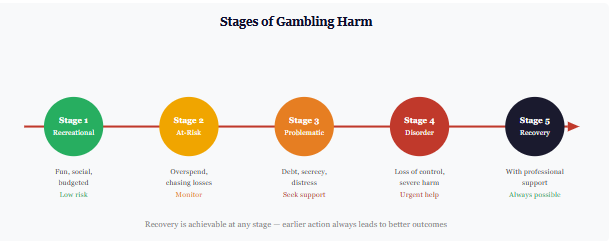
The five stages of gambling behaviour: from recreational play through to recovery. No stage is permanent.
UK Bank Gambling Blocks
A growing number of UK banks now offer free gambling transaction blocks directly within their mobile apps or online banking portals. When activated, these blocks prevent any payments to gambling merchants from being processed on your card or account — adding a practical financial barrier on top of casino-level tools.
Banks currently offering gambling blocks in the UK include Barclays, HSBC, Lloyds, NatWest, Halifax, Monzo, and Starling Bank. Enabling the block typically takes under a minute in the app, and most banks build in a mandatory cooling-off period before the block can be removed — providing a valuable pause during impulsive moments. We strongly recommend using a bank gambling block as part of a layered approach to limiting your gambling activity.
Self-Exclusion and Gambling Blocking Tools
For players who want to take a decisive break from gambling, the UK offers a well-developed ecosystem of self-exclusion programmes and specialised blocking software. These tools are free or very low cost, and they have helped many thousands of people in the UK significantly reduce or eliminate their gambling activity.
GAMSTOP — National Self-Exclusion
GAMSTOP is the UK’s national online self-exclusion scheme, operated in partnership with the UK Gambling Commission. Registering takes only a few minutes and immediately flags your details across all UK-licensed online operators — preventing you from opening or accessing gambling accounts with them for your chosen period of six months, one year, or five years. It is entirely free and one of the most powerful responsible gambling tools available to UK players.
Gambling Blocking Software
- Gamban — Blocks thousands of gambling websites and apps across all your devices. Widely recommended by UK support services. Low annual subscription.
- BetBlocker — Free tool that blocks gambling sites across up to five devices simultaneously. Includes optional time-lock to prevent easy removal.
- GamBlock — Robust, difficult-to-bypass blocking software. Particularly suitable for users who need strong, consistent protection.
- Net Nanny — Parental control tool effective at blocking gambling content on family devices used by children or vulnerable individuals.
We recommend installing blocking software across every device you use — desktop, laptop, tablet, and smartphone — for the broadest possible protection.
Emotional Wellbeing and the Gambling Connection
Gambling and emotional wellbeing are closely linked. Many people begin gambling during periods of low mood, stress, or anxiety, drawn to the distraction and temporary excitement it offers. Over time, however, gambling tends to amplify rather than relieve emotional difficulties. The financial strain, secrecy, and loss of control associated with gambling harm are all powerful drivers of worsening mental health.
If you recognise that you gamble primarily to manage difficult emotions rather than for entertainment, this is a pattern worth addressing directly. Exercise, social connection, creative hobbies, mindfulness, and professional talking therapies are all evidence-based alternatives to gambling as an emotional coping strategy — without any of the financial or psychological risks.
Gambling Therapy provides free online counselling and peer support groups for people experiencing gambling-related emotional difficulties, including dedicated support for anxiety and depression linked to gambling harm.
UK Support Organisations and Treatment Services
The UK has a strong network of free, specialist gambling support services, from 24-hour helplines through to residential treatment for severe cases. Whatever stage you are at, there is a service that can genuinely help.
Helplines and Counselling
- BeGambleAware — The UK’s leading responsible gambling charity. Free 24/7 National Gambling Helpline (0808 8020 133), online chat, and a nationwide treatment referral network.
- GamCare — Free counselling, recovery programmes, peer support forums, and dedicated resources for affected family members.
- Gamblers Anonymous UK — Peer support fellowship running in-person and online meetings across the UK using the proven 12-step recovery model.
- Gambling Therapy — Free international online support with UK-specific resources, moderated forums, and one-to-one therapy.
- BigDeal — Specialist support for young people under 25 and the adults who care for them, covering gambling education and early intervention.
NHS Specialist Gambling Clinics
- National Problem Gambling Clinic, London — The UK’s most established NHS gambling treatment clinic, offering comprehensive assessment and evidence-based psychological therapy for adults.
- NHS Northern Gambling Service — Free assessment and therapy for people in Northern England experiencing gambling disorder.
- NHS Southern Gambling Service — NHS-funded individual and group therapy for people in Southern England and their affected family members.
- West Midlands Gambling Harm Clinic — Provides CBT and financial counselling for gambling harm in the Midlands region.
- Gordon Moody — Intensive residential treatment for people with severe gambling disorders, plus online therapy and supported housing.
Protecting Children and Vulnerable Individuals
Our website is intended strictly for adults aged 18 and over. Gambling content — including casino reviews, bonus guides, and strategy articles — is entirely inappropriate for minors and for individuals who are particularly vulnerable to gambling harm due to mental health conditions, substance misuse issues, or financial crisis. We take this responsibility very seriously.
If children have access to the devices you use, please install parental control software to block gambling-related content. Net Nanny is one of the most effective options available, capable of filtering gambling sites across browsers and apps on multiple devices. BigDeal offers specialist support for young people who are developing problematic gambling habits, as well as guidance for parents, teachers, and youth workers who have concerns about a young person in their care.
All UK-licensed casinos are legally required to carry out age verification before allowing any account to be created. Any operator that fails to do so is in serious breach of UK Gambling Commission regulations and should be reported to the Commission directly.
Support for Families and Loved Ones
If someone close to you is struggling with gambling, you may be experiencing a mixture of worry, frustration, guilt, and helplessness. These feelings are completely normal, and you deserve support too — not just the person who is gambling. You cannot force a loved one to seek help, but you can protect your own finances, set clear personal boundaries, and access support that helps you manage the situation more effectively.
GamCare offers free one-to-one counselling specifically for friends and family members of people experiencing gambling harm. Gamblers Anonymous UK runs GamAnon — a companion programme for people affected by another person’s gambling — with meetings available in person and online across the UK. Reaching out for your own support is not a betrayal of the person you are trying to help; it is essential for your own wellbeing and for your ability to support them sustainably.
Seeking Professional Help: When and How
The most common reason people delay seeking help for a gambling problem is believing the situation is not serious enough yet. This is an understandable but costly mistake — the evidence consistently shows that earlier intervention produces significantly better outcomes. If you are asking yourself whether you might have a gambling problem, that question itself is worth taking seriously.
Your GP is a straightforward starting point. They can refer you to NHS specialist gambling services and assess whether co-occurring conditions such as anxiety or depression need treatment alongside gambling disorder. If you prefer not to start with your GP, the BeGambleAware helpline (0808 8020 133) can direct you to appropriate services in your area with complete confidentiality.
Crisis support: If you are experiencing thoughts of self-harm or suicide related to gambling, please contact Samaritans immediately on 116 123 (free, 24/7) or text SHOUT to 85258. In an emergency, call 999 or go to your nearest A&E department.
About Our Website and Affiliate Disclosure
Midnite Casino is an independent information and review website covering UK-licensed online casinos, bonuses, slots, payment methods, and gambling guides. All content is published for informational purposes only and does not constitute financial advice or an endorsement of any specific product or operator. We do not operate a casino, accept deposits, or process bets.
Some links on our website are affiliate links, meaning we may receive a commission when a reader clicks through and creates an account with an operator we have reviewed. This commercial arrangement does not affect our editorial independence or the accuracy of our reviews. We cover only casinos that hold a valid UK Gambling Commission licence. Full details of our commercial relationships are set out in our Terms and Conditions and Privacy Policy. For background on who we are, visit our About page. Common reader questions are answered in our FAQ section.
Frequently Asked Questions
Is gambling on UK-licensed sites safe?
UK-licensed casinos are regulated by the UK Gambling Commission and must meet strict standards for player protection and fair play. While regulated gambling is significantly safer than unlicensed alternatives, all gambling carries financial risk. Using responsible gambling tools — deposit limits, session timers, self-exclusion — reduces that risk meaningfully.
How do I know whether my gambling has become a problem?
Key signs include spending more than planned, chasing losses, hiding gambling from people close to you, gambling with essential bill money, and feeling unable to stop. BeGambleAware’s free online self-assessment tool offers a private, non-judgemental way to evaluate your current relationship with gambling.
Does GAMSTOP cover all online casinos?
GAMSTOP covers all operators holding a UK Gambling Commission licence. It does not apply to offshore casinos licensed in other jurisdictions. This is why we only recommend casinos with valid UK Gambling Commission licensing — their compliance with GAMSTOP and other player protection requirements is a key criterion in our reviews.
Can I remove gambling blocking software whenever I want?
Most responsible gambling blocking tools such as Gamban and GamBlock are intentionally designed to be difficult to remove during an active exclusion period. Many include mandatory time-lock features that require a reflection period before any removal request can be processed. This is a deliberate safeguard against impulsive decisions.
Where can a family member get support?
GamCare provides free counselling specifically for friends and family members affected by another person’s gambling. Gamblers Anonymous UK runs GamAnon meetings — a dedicated fellowship for those living with a problem gambler — available in person and online across the UK.
Is gambling support free in the UK?
Yes. The vast majority of gambling support in the UK — including the BeGambleAware helpline, GamCare counselling, Gamblers Anonymous meetings, BetBlocker software, and NHS specialist gambling clinic treatment — is available free of charge. Cost should never be a reason to delay seeking help.
Does this website offer gambling services?
No. Midnite Casino is an affiliate information and review website only. We publish casino reviews, guides, and responsible gambling content. We do not accept bets, process deposits, or operate any gambling service. All gambling activity takes place directly on the licensed casino platforms we write about.
Contact Information
If you have a question about responsible gambling, a concern about something on our website, or wish to get in touch for any other reason, please use the contact details below. We aim to respond to all enquiries within two working days.
| Contact Method | Details | Best Used For |
|---|---|---|
| [email protected] | Responsible gambling queries, editorial feedback, general enquiries | |
| Contact Form | midnite-casinos-uk.com/contact/ | All general enquiries and responsible gambling questions |
| Legal Correspondence | Email above, subject line: “Legal” | GDPR requests, legal notices, compliance matters |
| Gambling Helpline (UK) | 0808 8020 133 — BeGambleAware, free, 24/7 | Immediate gambling support — not operated by us |
| Crisis Line | 116 123 — Samaritans, free, 24/7 | Emotional crisis or thoughts of self-harm |
Disclaimer: Midnite Casino is an independent affiliate review and information website. We do not operate gambling services and accept no responsibility for the content, terms, or conduct of any third-party operator linked from our pages. Gambling involves financial risk. Please gamble only with money you can afford to lose, only if you are aged 18 or over, and only if you are not subject to a self-exclusion agreement. If gambling is causing you harm, please seek professional support without delay. Our Terms and Conditions and Privacy Policy contain full details of our practices and commercial relationships.